

The cupboard
The scorebook goes into a cupboard.
A season of innings becomes a physical object nobody opens again. Nothing about it is searchable, comparable or portable.
While professional teams have analysts, archives and tools, the pitches that produce tomorrow's stars keep records in notebooks and WhatsApp threads. CreaseTech gives grassroots cricket a modern home — scheduling, facility management, role-based drills, match score ingestion and data-driven insights — so every session, match and milestone becomes part of a visible, coachable journey.
Your journey matters —
the beginning defines how you reach the destination.
CreaseTech captures training, matches and milestones so players, coaches, guardians and admins can plan, measure and celebrate progress.

From first net to first selection.
Every training counted. Every innings kept. Every player seen. Every season proven.
Most of the people on this platform are children. It has been designed accordingly.
See the child-safety commitmentsOn grassroots grounds and in practice nets across the world, young players train, bat, bowl and field, and coaches who know their craft watch closely and judge well. Then the season closes.
The cupboard
A season of innings becomes a physical object nobody opens again. Nothing about it is searchable, comparable or portable.
The hard work
Months of early mornings and late evenings, the sweat and the bruises — with no record of the sessions done or the drills worked on. Only a memory, and memories fade.
The handover
Years of development knowledge leave with them. The next coach begins again from the first delivery — and the coach who did the work is forgotten.
The scroll
Planning, strategies, attendance, fees, fixtures, feedback and photographs all live in a feed that deletes itself by design.
Three seasons of work later, the player has almost nothing to show for it — and the institution cannot prove what it built.
Cricket has never been short of talent. It has been lacking how we nurture them.
CreaseTech keeps the record where the work happens — so the season, the sessions and the coaching all outlive the scorebook.
We are building one platform where the operational life of a cricket institution — training catalogues and plans, sessions, fixtures, attendance, fees, communications and performance — lives in a single connected system.
Every session a player attends and every innings they play becomes part of a permanent, verified, portable development record that belongs to them and outlasts any one coach, term or committee.
Built around overs, innings, spells, sessions, drills and age groups — the vocabulary a Master-in-Charge already uses. Generic sports software makes coaches translate; we don't.
Designed for the Sri Lankan grassroots game as it actually runs — the school calendar, the inter-school season, local payment habits, local scoring sources, and phones running on mobile data.
Portable across schools, academies and clubs. A player who moves does not start again from zero, and a coach's contribution stays attributed.
Vision
Talent is not cricket's problem today. Memory is. We want a generation of players whose work is visible wherever they go, and schools, academies and clubs that can prove what they built.
Mission
We give players, coaches, parents, and the schools, academies and clubs behind them one place to record every session and every innings, see honestly how the work is developing, and decide what comes next. By joining a player's full development record to the coaching knowledge around it and the real context of each match, we turn scattered effort into evidence — so that whenever someone looks, the work is there to be seen.
We do not select players, we do not coach, and we will not promise a win, a cap or an improvement percentage. What we promise is that when a selector, a parent or a committee looks — the evidence exists.
“Excellence is not a singular act, but a habit. You are what you repeatedly do.”
So we built a loop that carries a young cricketer towards excellence.
Stage 01 of 03
Coaching data
Coach logged: batting stance drill, week 6; next focus: footwork.
18 sessions4 drills tagged92% delivered
Training data
Footwork block: 8 of 10 sessions delivered; balance drill trending up.
34 sessions+21% improvement2 blocks missed
Performance data
Match record: 3 dismissals to a 6-ball length; return to back-foot drills.
16 innings41% on one lengthNext focus set
Stage 01
Coaching data records what was taught, to whom, and at which stage of a player's development.
A coach opens the squad and sees the stance work already covered in week six.
Guidance becomes individual instead of repeated.
Hover or tap a node for a live example.
Stage 02
Training data tracks how that work develops across weeks and terms, measured rather than remembered.
Eight weeks of footwork sit in one line, so progress stops being a feeling.
Improvement is evidence, not recollection.
Stage 03
Performance data from matches shows precisely which areas go back to the board next term.
Three dismissals to the same length tell the coach what next week has to fix.
The next plan starts informed, not blank.
The institution
A season's record that survives the people who created it — administration, scheduling, billing and reporting in one governed system.
Six seasons · three coaches · one unbroken record
Three coaches, two age groups, one continuous record. Nothing leaves when they do.
The coach
Squad development visible at a glance, administrative load carried by the system rather than by hand, and the evidence behind the interventions you already know are needed.
The player
What you are working on, how it is developing, and a record of your own that travels with you between institutions.
The caregiver
Your child's growth shown plainly, inside a structured and accountable training environment — with you in control of what is shared.
The early years set a player's trajectory — and almost none of those years are kept. A season ends, and the record leaves with the coach.
And at the level above, the talent and its history sit in one place — sliceable by age, role, format and conditions, so the next generation of squads is built on evidence.
One unified platform for grassroots cricket — looking beyond today's match.
Did the term's training objectives actually show up in match returns?
Session volume, drill exposure and workload set against runs, wickets, strike rate and economy.
Recurring dismissal and economy patterns matched to the drills that address them — and whether they ran.
Progress against the player's own baseline and their age and skill squad.
A worked example built from one term of school cricket — the objectives set, the sessions delivered and what the scorebook returned.
Each module delivers its own value — but together they create a seamless development chain. A session scheduled becomes a session attended, becomes drills completed, becomes a season programme. Training connects to match performance, performance becomes insight, and insight becomes a record that can be shown, shared and built upon.
The cricket work — planned, delivered, measured.
Structured drills, tagged to the skill being coached.
Term plans built from the catalogue, reused each season.
Innings, spells and dismissals read as a season.
What the record gives back.
Committee reports generated, not reconstructed.
Consent-gated, age-aware recognition.
The player's season and career record, kept.
Onboarding, scheduling, facilities, fees.
Centralised profiles, guardian consents, role tags.
Grounds, nets, coaches and kit in one calendar.
Invoices, receipts and fee position, always current.
One record instead of five chat groups.
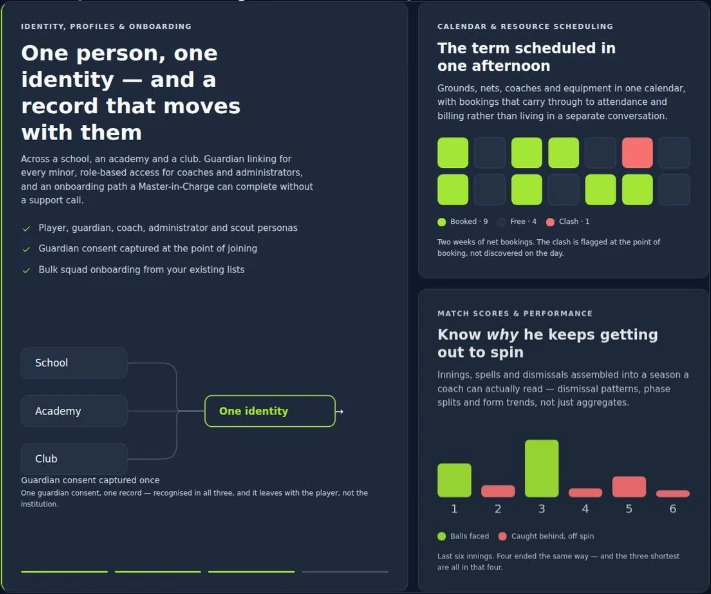
The operational spine: build squads and age groups, schedule the term, mark attendance in the field on a phone, and capture what happened while it is still fresh.
Announcements, reminders, receipts and consent requests — sent from the system that holds the facts, with a record of what was sent, to whom, and when.
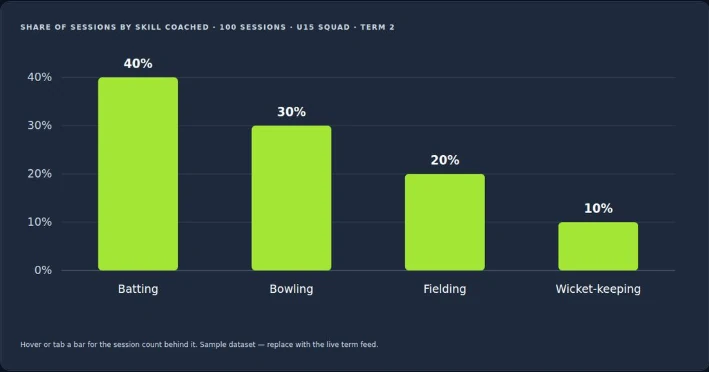
A structured drill and skill catalogue, plans built from it, and a record of what was actually delivered to each player — the coaching data that starts the loop. Below: one term's drill load for an under-15 squad, broken down to the skill being coached.
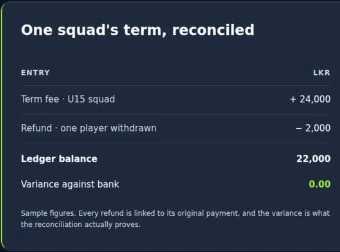
Everything an institution runs behind the cricket: term fees and guardian payments, roles and permissions, seasons and settings — with a double-entry ledger behind every rupee, every refund linked to its payment, and a reason code attached to every action.
The people who use it, the platform that runs the institution, the record it builds, and the outside services it connects to.
Five roles, one governed system
The cycle they run
Each role sees only what their permission allows.
Everything an institution runs
Every action consented and audited.
Kept across seasons, owned by the player
It belongs to the player and travels with them.
Connected, never in control · outside your institution
Data flows out only where consent allows it.
Read it as a sentence: the people record the work, the platform turns it into one record, and that record only leaves the institution through the consent gate. Scores and fee settlements come back the other way — read only, never authoritative.
From scheduled session to completed drills, from season plan to match performance, and from data to a shareable record. Click any stage to see the raw data it holds, the metrics derived from it, and what it tells a coach to do next.
Reproducible from the underlying record, every time. Squad depth, participation, attendance, fee position and development progress — the reports a committee actually asks for.
Squad performance
4 of 12
first-innings leads converted to outright wins
4 converted · 8 not
Player progress
19 of 36
scores past 30 that went on to a fifty — 52.8%
19 converted · 17 did not
Skill gap
22% → 15%
of overs bowled to off spin returned this share of wickets
Same scale. The gap is the finding.
Once the record exists and consent allows it: discovery of coaches and facilities, age-group leaderboards, and moments a family can share. Minors pseudonymous and opt-in only. Share cards are generated from verified data, never from claims, and nothing leaves your institution without passing all four consent gates.
Readiness score
74 / 100
Workload
9.4 hrs/week
Skill progression
+12% this term
Attendance
91% of sessions
Recognition for work done, not just runs scored. Two safeguards hold throughout: leaderboards are pseudonymous for under-16s, and badges are visible to guardians before they are visible to anyone else.
Drills completed · under-16 · this term
Streaks measure participation. Nothing is published outside the institution without passing all four consent gates.
Grounds, nets, coaches and equipment in one calendar. Bookings carry through to attendance and billing rather than living in a separate conversation, and clashes surface as you make them.
Track progress, get personalised drills, build your own record.
Plan the term, see what worked, get your time back.
See where your child stands, and consent to what is shared.
Run the season, prove the investment, keep the record.
How is our preparation for the next season? Have we done enough for the next Big Match? Don't sit in the dark — CreaseTech shows you where your team actually stands.
The term is scheduled in one place, attendance is marked on a phone at the ground, and the first report the committee asks for is generated instead of reconstructed.
You know he keeps getting out to spin. Can you prove when it started?
Replace coaching judgement. The platform tells you where to look and what changed. The diagnosis, the intervention and the relationship remain entirely yours.
Where do I need to improve? What do I actually have to do to get better?
No platform selects players. What this one does is make sure that when someone looks, the evidence of your work exists — because today, for most players, it does not.
How is my child progressing? Where do they need our support?
Guardian views show your own child's development over time. We do not rank children against each other, and we do not tell you your child is behind.
It has been designed accordingly. Guardian linking and consent controls, age-appropriate access restrictions, permission-based visibility, role-based access, complete audit trails, and data export and erasure rights are enforced by the system itself — rather than promised in a policy document.
Nothing about a young player becomes visible beyond their institution unless the right people have agreed to it.
Request the child-safety briefGate 01
The record is attached to a resolved player identity, not a name typed twice.
Gate 02
A minor's data does not leave the institution without the guardian's explicit permission.
Gate 03
Your school decides whether it publishes at all, and under whose name.
Gate 04
Who exactly can see it, for how long, and how quickly it can be withdrawn.
Retention, portability and access — each auditable. Data is stored securely, access is logged, and guardian consent is required for every profile belonging to a minor.
A player's record is retained while their institution holds a relationship with them, and travels with the player on request. Consent records are timestamped and kept for the life of the account.
Players and guardians can export the full record. Export requires guardian or admin approval, and every export is logged and time-stamped.
Role-based permissions with least-privilege defaults. Admins audit permissions and issue temporary access from one console.
Built by people who live and breathe cricket — and who have stood in enough nets, on enough boundary lines and in enough planning meetings to know how the grassroots game actually works.
Because we believe the kid at the far net deserves what the top of the game gets.
Because how a cricketer is brought up decides what that cricketer becomes.
A new era for the grassroots game, built for the game we grew up in — by people who never really left it.
Not customers yet — collaborators. Early adopters who would like to join hands and help us roll out the best possible product for the development of grassroots cricket.
Names published only with each institution's written permission.
Honest feedback through the build, one committee conversation, and permission — if you are happy — to say you were first.
 Serendib International Cricket Academy
One academy has committed so far. Two more are in conversation, and we will name them here the day they say yes — not before.
Crease It is where we write about cricket in public. Brief analysis of current cricket affairs and match analysis — the same way we read a scorecard inside the platform, applied to the games everyone is already watching. It is how we build a following, and how you can see how we think before you ever log in.
What is happening in the game right now, read short and read straight — selections, schedules, structures, and what they mean for the players coming through.
One match, a handful of numbers, and the passage that decided it. Exposure-normalised, the way a coach would want it, not a highlights reel.
Free to read, no account needed. If it is useful to a supporter, it is useful to a coach — and that is the audience we are building.